 Alessandro Romano · ·
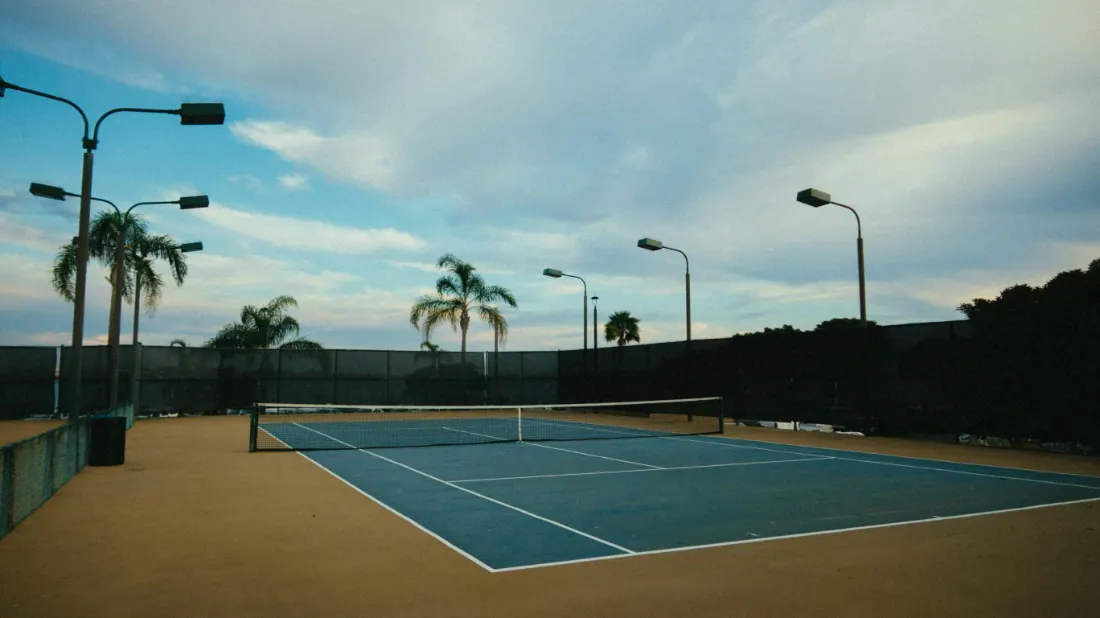
A tennis court is 23.77 m (78 ft) long and 10.97 m (36 ft) wide for doubles, or 8.23 m (27 ft) wide for singles, with a net 0.914 m (3 ft) high at the centre. With the run-off the International Tennis Federation (ITF) recommends around it, one court needs about 36.6 × 18.3 m (120 × 60 ft), roughly 670 m².
The measurements were fixed in the nineteenth century, in feet, which is why the metric figures look so oddly specific. Whether you are building courts, repainting lines, converting a court to another sport or settling an argument, this guide gathers every number in one place.
The court at a glance
The International Tennis Federation (ITF) sets the rules. The full court is a rectangle 23.77 m (78 ft) long. Its width depends on the game:
| Measurement | Metric | Imperial |
|---|---|---|
| Length, baseline to baseline | 23.77 m | 78 ft |
| Singles width | 8.23 m | 27 ft |
| Doubles width | 10.97 m | 36 ft |
| Each doubles alley | 1.37 m | 4.5 ft |
| Net to service line | 6.40 m | 21 ft |
| Service line to baseline | 5.49 m | 18 ft |
| Service box | 6.40 × 4.115 m | 21 × 13.5 ft |
Inside the lines, that makes about 261 m² (2,808 ft²) for doubles and 196 m² (2,106 ft²) for singles.
Lines and marks
- Line width: between 2.5 and 5 cm (1 to 2 in) for all lines, except the baseline, which may be up to 10 cm (4 in).
- Centre mark: a short mark, 10 cm (4 in) long, at the middle of each baseline, used to position the server.
- Centre service line: divides the area between the net and the service lines into the two service boxes on each side.
All measurements are taken to the outside of the lines, and the lines are part of the court: a ball touching the line is in.
The net
- Height at the centre: 0.914 m (3 ft).
- Height at the posts: 1.07 m (3.5 ft).
- Posts placed outside the doubles sideline by: 0.914 m (3 ft).
The net is held down at the centre by a strap. On a court used for both singles and doubles, singles sticks raise the net at 0.914 m (3 ft) outside the singles sidelines, so singles players face the correct height.
Space around the court
Players need room to chase balls beyond the lines. The ITF recommends:
- 6.40 m (21 ft) behind each baseline;
- 3.66 m (12 ft) beside each sideline.
That gives a recommended total area of about 36.57 × 18.29 m (120 × 60 ft), roughly 670 m², for one court. Top-level events use more, both for players and for officials and cameras.
Where several courts sit side by side, a run-off of around 3.66 m (12 ft) between courts is a good standard; separating fences or nets help keep stray balls off the next court.
Indoor courts
Indoor courts follow the same lines, with two extra concerns:
- Clear height. Lobs need space. A clear height of about 9 m above the net is a common recommendation for club play, decreasing towards the back of the court; competition halls are higher. Measure the lowest beam, light or duct, not the roof.
- Lighting and background. Even lighting without glare, and dark, plain back walls so players can see the ball.
Mini tennis courts
Children learn on smaller courts with slower balls, a system the ITF promotes as Play and Stay:
- Red stage, with the slowest red ball: a court of about 11–12.8 × 4.3–6.1 m, often laid across half a full court.
- Orange stage, with the orange ball: about 17–18.3 × 6.1–8.23 m.
- Green stage, with the green ball: the full-size court.
Temporary lines and portable nets let a club fit several red courts on one full court, which is ideal for junior programmes.
Surfaces
The surface changes how the ball behaves. The ITF classifies surfaces by pace, from slow to fast. The main families are:
- Clay (red brick dust or green clay): slow, high bounce, kind to joints, needs daily care and watering.
- Hard courts (acrylic on asphalt or concrete): consistent, low maintenance, medium to fast.
- Grass: fast and low bouncing, beautiful but costly to maintain.
- Artificial grass with sand infill: popular at clubs for its all-weather play and low upkeep.
- Carpet and other indoor surfaces: varying pace, used in halls.
For a club, the right surface depends on climate, budget, maintenance capacity and what members prefer. Many clubs mix two surfaces.
Tennis next to padel and pickleball
Clubs considering other racket sports often ask how they compare in space (more in our padel court guide and our padel vs pickleball comparison):
- Tennis (doubles): a 23.77 × 10.97 m playing area, about 36.6 × 18.3 m with recommended run-off, a net 0.914 m high at the centre, no walls.
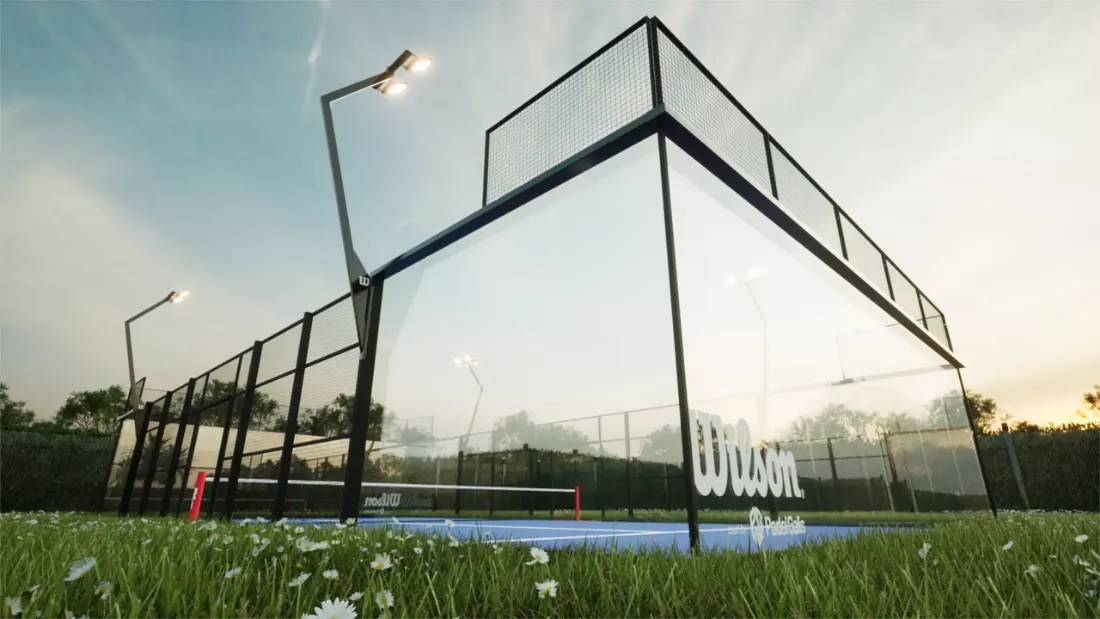
- Padel: a 20 × 10 m playing area, about 21 × 11 m per court with its structure, a net 0.88 m high at the centre, walls in play.
- Pickleball: a 13.41 × 6.10 m playing area, about 18.3 × 9.1 m with run-off, a net 0.864 m high at the centre, no walls.
One full tennis court with its run-off can usually host two or three padel courts, or up to four pickleball courts. Pickleball lines can also be painted on a tennis court in a different colour, so both sports share the surface at different times.
Planning checklist for new courts
Fill your courts with PLAI
Pay nothing. Get everything. PLAI is 100% free to run your venue: no subscription, no contract, no limits. Each tennis court becomes a space in your calendar with its own opening hours and prices. Members book and pay from the app, coaches see their lessons in the same calendar, your team can block a court for clay maintenance or resurfacing, and the analytics show which courts and hours fill, so you know where demand really is. See PLAI Business, and our guides to running a tennis club and building a tennis academy.
FAQ
How big is a tennis court?
23.77 × 10.97 m (78 × 36 ft) for doubles, 23.77 × 8.23 m (78 × 27 ft) for singles, measured to the outside of the lines.
How high is a tennis net?
0.914 m (3 ft) at the centre and 1.07 m (3.5 ft) at the posts.
How much space does a tennis court need in total?
About 36.6 × 18.3 m (120 × 60 ft) with the ITF's recommended run-off.
How high should an indoor tennis hall be?
A clear height of about 9 m above the net is a common recommendation for club play; measure the lowest beam or light.
Can I paint pickleball lines on a tennis court?
Yes. Use a different colour so both sports can share the surface at different times; one tennis court can hold up to four pickleball courts.